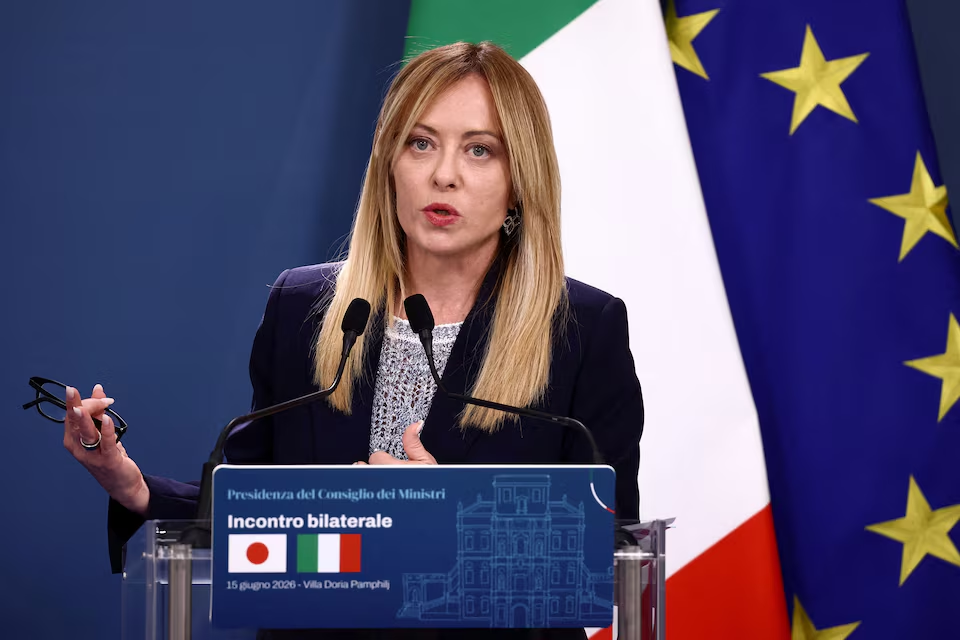
Italian Prime Minister Giorgia Meloni has applied to trademark her voice with the European Union Intellectual Property Office in a move aimed at strengthening legal protection against the growing use of artificial intelligence to create convincing deepfakes.
Records on the EUIPO website showed that the application was filed on October 5 and includes a four-second audio recording in which Meloni repeats the phrase, “I am Giorgia,” twice in Italian.
Her office confirmed the application.
The move comes as advances in generative artificial intelligence have made it increasingly easy to create realistic audio, images and videos of public figures saying or doing things they never actually said or did.
Meloni has herself been repeatedly targeted by manipulated content circulating online. In some cases, altered images have been presented as genuine, raising concerns over the ability of social media users to distinguish authentic material from AI-generated or digitally manipulated content.
The Italian leader has previously warned about the risks posed by deepfakes and urged people to verify material before sharing it. She has also argued that while public figures may have greater resources to defend themselves against fabricated content, ordinary people can be particularly vulnerable to the technology.
Her trademark application is closely associated with her public identity. The phrase “I am Giorgia” became one of Meloni’s best-known political slogans after she used it during a 2019 rally. It later became the title of her 2021 autobiography and was even turned into a disco track.
The application is still being examined by EUIPO and it is not yet clear whether it will be approved.
Trademarking the voice would not automatically prevent people from using AI to imitate Meloni or stop every deepfake featuring her. However, legal experts and Italian media have reported that approval could provide an additional legal basis for challenging unauthorised commercial or other protected uses of her voice and make it more difficult for individuals or companies to exploit her identity.
The development highlights the growing legal challenges created by AI-generated content, particularly as voice-cloning technology becomes capable of reproducing a person’s speech with increasing accuracy from relatively small amounts of audio.
AI-generated voices can potentially be used to make public figures appear to endorse products, make political statements, issue false announcements or participate in conversations that never occurred. Such content can spread rapidly on social media before it is identified as fake.
For political leaders, the problem carries additional risks because fabricated statements can potentially affect public opinion, financial markets or perceptions of government policy.
See also: Honda to Test Roads That Wirelessly Charge Moving Electric Trucks
Meloni has already taken legal action over the misuse of her image. In 2024, she launched a civil case against a man from Sardinia who was accused of creating and distributing pornographic deepfake images using her face.
That case remains before an Italian court and has added to the Italian prime minister’s public warnings about the misuse of artificial intelligence and manipulated digital content.
Her latest move therefore places greater emphasis on protecting not only her image but also another distinctive element of her identity: her voice.
The application comes amid wider efforts in Europe to address the legal and social risks associated with artificial intelligence, including the misuse of synthetic media and content designed to deceive the public.
For Meloni, securing trademark protection could give her another legal tool to challenge unauthorised uses of her identity as AI-generated audio becomes more difficult to distinguish from genuine recordings.
The application will now go through the EUIPO examination process before a decision is made on whether the trademark can be registered.

About the Author
Cecilia Attah is a tech analyst with a degree from Benue State University. She covers tech news and startups at TechRegard with a focus on how technology is transforming Africa and shaping the global landscape.