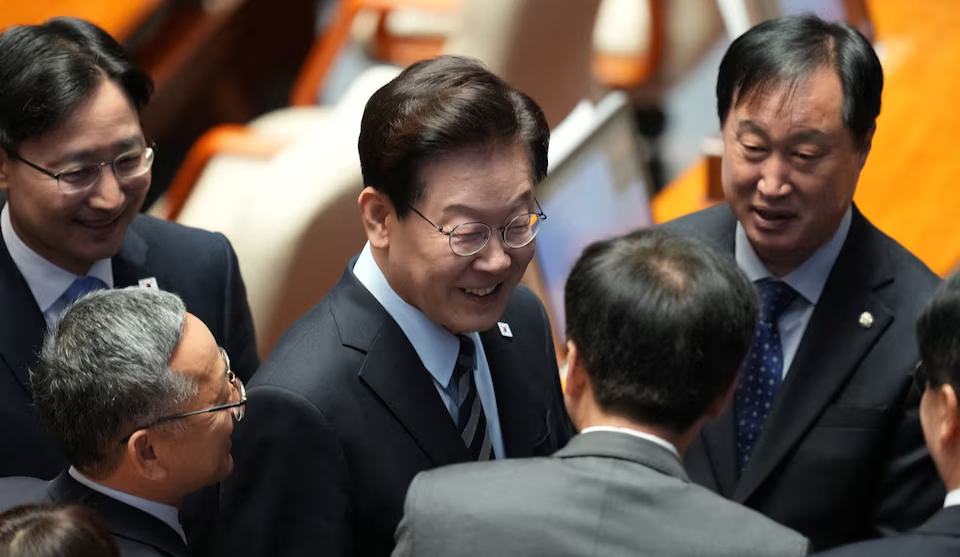
South Korean President Lee Jae Myung has pledged nearly $16bn in investment in artificial intelligence and related technologies as his administration seeks to strengthen the country’s position in the intensifying global AI race.
Lee made the commitment on Monday while presenting his government’s 2027 budget proposal to parliament, which includes a record 12.8 per cent increase in public spending to 820.9 trillion won ($615.62bn).
Under the proposed budget, the government plans to commit 21.3 trillion won ($15.97bn) to artificial intelligence and three major technology projects focused on semiconductors, physical AI and AI data centres.
The allocation is nearly double the amount earmarked for the sectors in the current year’s budget, reflecting the government’s ambition to turn South Korea’s technological strengths into a broader source of economic growth.
“We will invest 21.3 trillion won ($15.97 billion), nearly twice this year’s amount, in AI and the three megaprojects of semiconductors, physical AI and AI data centres,” Lee told lawmakers.
The investment comes as countries and major technology companies compete to develop advanced AI systems and secure the computing infrastructure needed to power them.
South Korea is particularly well positioned in the semiconductor market, with demand for advanced chips used in AI systems boosting exports and earnings at major manufacturers Samsung Electronics and SK Hynix.
The country’s economy grew faster than expected in the third quarter of 2026, supported by strong chip exports and investment. Its exports reached $930bn between January and October, putting it on course to exceed $1tn for the first time.
Lee said the milestone was now within reach but warned that the country’s economic gains were not being distributed evenly among businesses, regions and citizens.
“We must make a great transition from ‘growth for the few,’ in which opportunities and gains are concentrated among certain regions, classes and a small number of companies, to ‘growth for all’,” he said.
Beyond the AI allocation, the proposed budget establishes a 162.3 trillion won Future Response Fund, largely backed by additional tax revenue generated by the semiconductor boom.
The fund is designed to support emerging industries, young people, regional development and education, while providing a financial buffer against possible revenue shortfalls in the future.
Lee’s administration is also pursuing large-scale technology projects built around semiconductors, physical AI and data centres. One of the major initiatives involves an 800 trillion won private-sector semiconductor investment programme led by Samsung and SK Hynix in the country’s southwest.
See also: Anthropic Eyes $1.75tn Valuation as It Files for US IPO
The proposed spending increase is part of a broader effort to sustain South Korea’s technological competitiveness while expanding the benefits of economic growth.
Lee also highlighted improvements in the country’s fiscal outlook, saying the budget would reduce the fiscal deficit to 0.1 per cent of gross domestic product in 2027, from 3.9 per cent this year.
The government expects the debt-to-GDP ratio to fall to 48.3 per cent, compared with 51.6 per cent in 2026.
Lee said the stronger fiscal position and the proposed Future Response Fund had received positive assessments from international organisations and major credit rating agencies.
Meanwhile, Citi economist Kim Jin-wook said South Korea could have an opportunity to improve its credit rating in the coming years, with potential funding for the Future Response Fund reaching 215 trillion won between 2026 and 2027.
Kim said the additional funding could support the country’s long-term economic growth while strengthening fiscal sustainability.
South Korea’s proposed budget must still receive parliamentary approval before it can take effect.

About the Author
Cecilia Attah is a tech analyst with a degree from Benue State University. She covers tech news and startups at TechRegard with a focus on how technology is transforming Africa and shaping the global landscape.