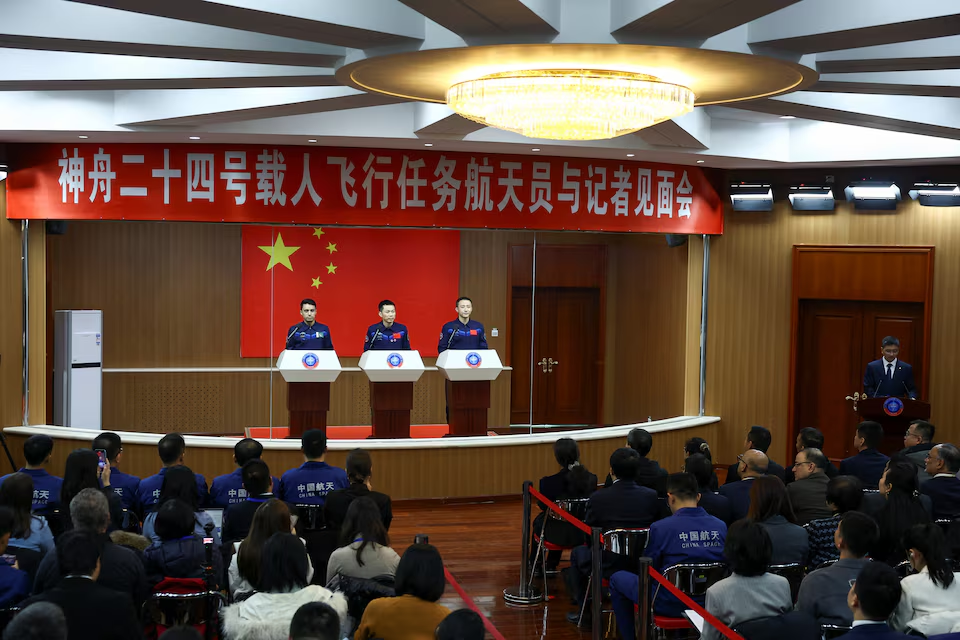
China is set to make history on Wednesday as it launches the Shenzhou-24 spacecraft carrying the first foreign astronaut to visit its Tiangong space station.
The three-member crew includes Chinese astronauts Tang Hongbo and Wu Yi, alongside Pakistani astronaut Muhammad Zeeshan Ali, whose participation marks a major step in Beijing’s international space cooperation.
The China Manned Space Agency (CMSA) said on Tuesday that the crew was in good condition and all preparations had been completed ahead of the launch, scheduled for 8:18 a.m. local time on Wednesday (0018 GMT).
The spacecraft will lift off aboard a Long March-2F rocket from the Jiuquan Satellite Launch Centre in north-western China.
Ali, who will serve as a payload specialist, is participating in the mission under a bilateral space cooperation agreement between China and Pakistan, linked to Beijing’s Belt and Road Initiative.
See also: Malaysia Orders Data Centres to Cut Ties With US-Blacklisted Megaspeed, Six Others
Unlike the Chinese astronauts, who are scheduled for a six-month stay aboard the station, Ali will undertake a short-term mission before returning to Earth with two members of the outgoing Shenzhou-23 crew.
China has operated regular crewed missions to its Tiangong space station since 2021, typically sending three astronauts for extended stays. The Shenzhou-24 mission will be the 41st flight of the country’s crewed space programme and will involve an orbital crew rotation with the Shenzhou-23 team.
Chinese authorities also disclosed that Zhu Yangzhu, a member of the outgoing crew, will remain in orbit for a year-long mission, extending the duration of China’s human spaceflight operations.
During their stay, the astronauts will conduct space science experiments and research activities aboard the Tiangong station.
The launch comes as China accelerates its ambitions in space, including plans to send astronauts to the Moon, in competition with the United States. Washington has accused Beijing of seeking to control and exploit lunar territory and resources, allegations China has rejected.
The inclusion of a Pakistani astronaut also highlights China’s efforts to expand international participation in its space programme as it develops Tiangong into a platform for scientific research and cooperation.

About the Author
Cecilia Attah is a tech analyst with a degree from Benue State University. She covers tech news and startups at TechRegard with a focus on how technology is transforming Africa and shaping the global landscape.