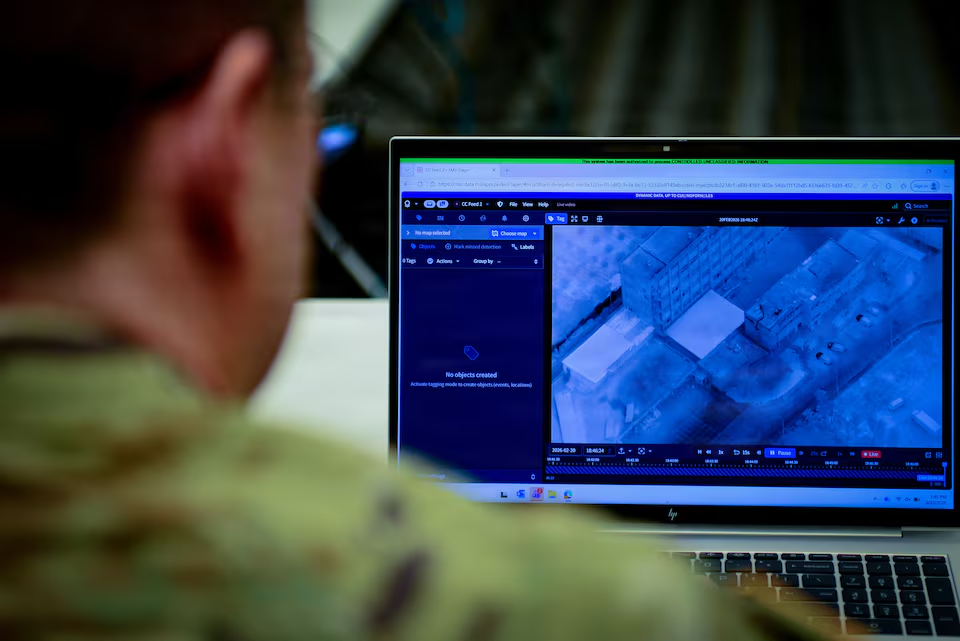
European countries are stepping up efforts to develop homegrown military software as defence ministries seek to reduce their reliance on American technology company Palantir Technologies amid growing concerns over strategic dependence on the United States.
Several European defence firms are competing to provide artificial intelligence-powered military systems capable of analysing large volumes of data, identifying potential threats and supporting battlefield decisions, including targeting operations.
The push gained momentum last week when German defence technology company Helsing unveiled Clarity, a military intelligence software designed to accelerate decision-making by processing vast quantities of information.
However, Europe currently lacks a direct equivalent of Palantir’s military software in terms of scale, operational experience and deployment capabilities, according to government and military officials.
This has created a dilemma for European militaries, which must choose between adopting locally developed systems that offer greater technological independence but may be less advanced, and continuing to rely on established American platforms.
The development comes as the administration of US President Donald Trump pushes European countries to assume greater responsibility for their security while Washington scales back its military presence in the region, raising questions about the future of the transatlantic NATO alliance.
France and Germany are among the countries leading the search for alternatives.
France is developing a sovereign AI-powered military platform known as Arcadia, which will involve multiple technology suppliers. Alexandre Lahousse, deputy head of the country’s defence procurement agency, told Reuters that the agency plans to award some contracts before the end of 2026, with an operational version expected to be ready for field deployment by mid-2027.
Germany, which also plans to introduce an AI-based military data integration platform from next year, is considering domestic and other European solutions.
A person familiar with the process said Germany had narrowed its options to a shortlist of a few suppliers, excluding Palantir.
Although the shortlisted systems would not match Palantir’s capabilities, they were considered sufficient to meet Germany’s requirements, guarantee national data sovereignty and deliver about 80 per cent of the needed capabilities within a year.
See also: Nexperia Dispute: China’s Wingtech Moves to Challenge Dutch Court Order
The Netherlands, which currently uses some Palantir software, is also seeking a European replacement within two years.
Dutch Defence Minister Derk Boswijk told Reuters that the country’s military was engaging potential suppliers and would likely adopt a combination of Dutch and other European technologies.
“We have a lot of knowledge in Europe when it comes to AI and decision-making. But it’s very fragmented, and that is the problem,” Boswijk said.
Palantir’s Maven Smart System has become a major platform for military intelligence and battlefield operations. Ukraine has widely used the software in its war against Russia, while the Pentagon has adopted it as its core military software and deployed it during its war with Iran this year.
NATO’s military headquarters adopted the Maven Smart System last year and announced in June that it was ready for routine operational use across the alliance.
The alliance’s top commander, US Air Force General Alexus Grynkewich, told Reuters this summer that he had yet to find another system capable of combining such a wide range of data and analysing it with similar flexibility.
However, European military officials have raised concerns about data security, AI training and the ability of different systems to work together during joint military operations.
Germany’s army chief, Lieutenant General Christian Freuding, said at a conference in Berlin on Friday that interoperability remained a major consideration for military technology, particularly when countries operate together under NATO.
“There’s the issue of interoperability when we fight in alliances — and we always fight in alliances,” he said.
Meanwhile, Helsing said it could deliver an initial version of its Clarity software to the German military’s Lithuania brigade within months. The unit is widely regarded as one of the Bundeswehr formations most likely to face frontline combat in the event of a conflict with Russia.
Other European companies developing military software include Denmark’s Systematic, whose SitaWare platform is already used by Germany’s armed forces and parts of NATO, as well as France’s defence firms Thales and Safran and Paris-based startup Comand AI.
Despite the growing push for European alternatives, Palantir is seeking to maintain its position in the region.
The company has previously reassured European customers that its Maven military AI system does not have a “kill switch”.
Palantir’s international chief, Louis Mosley, told Reuters that demand for its products remained strong in Europe, including the United Kingdom, whose Defence Ministry signed a three-year enterprise agreement with the company last year.
Mosley said he remained hopeful that Germany would eventually adopt Palantir’s software, arguing that its battlefield-tested capabilities were already available for immediate use.

About the Author
Cecilia Attah is a tech analyst with a degree from Benue State University. She covers tech news and startups at TechRegard with a focus on how technology is transforming Africa and shaping the global landscape.