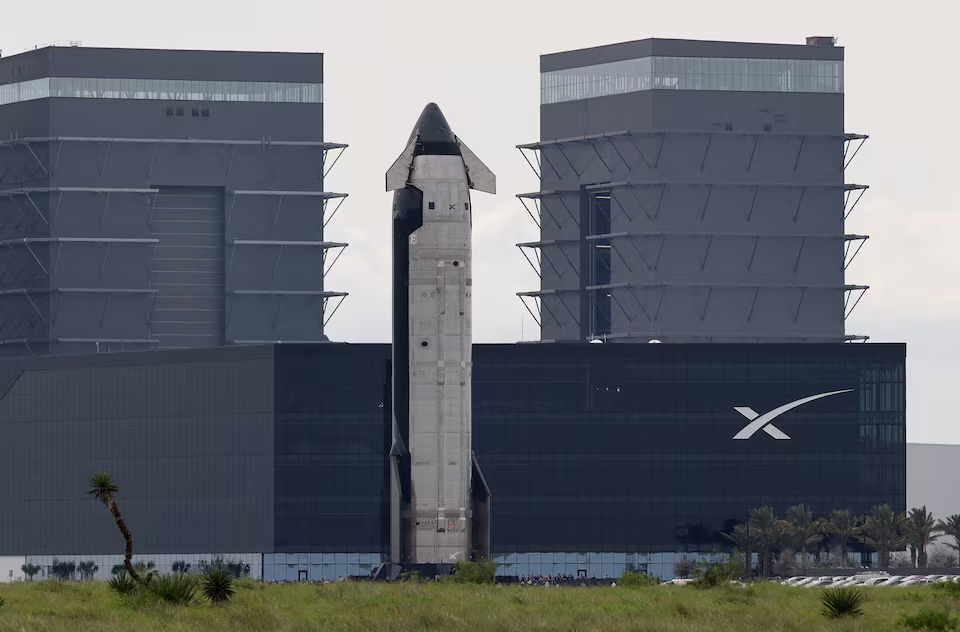
SpaceX is preparing to attempt its first recovery of the Starship spacecraft on land as Elon Musk’s company pushes towards developing a fully reusable rocket system.
The 15th test flight of the 407-foot (124-metre) Starship rocket is scheduled for Friday from the company’s Starbase launch facility in South Texas. The mission will mark the first time SpaceX attempts to bring both the rocket’s Super Heavy booster and its upper-stage spacecraft back to its Texas launch site.
Unlike previous missions, which ended with the spacecraft being discarded into the ocean, the latest flight is designed to test whether the two major sections of Starship can return safely and be captured for future flights.
The recovery attempt is a critical milestone in Musk’s plan to make Starship a rapidly reusable transportation system capable of carrying people, cargo and satellites into space at significantly lower costs.
SpaceX plans to launch the rocket at 4:45 p.m. Central Time (10:45 p.m. GMT), although the mission was still awaiting a launch licence from the US Federal Aviation Administration (FAA) as of Friday morning.
The FAA, which has typically issued approval a day before previous Starship launches, had not immediately responded to a request for comment.
The Super Heavy booster, measuring 236 feet, is expected to return to the launch site about 10 minutes after liftoff, where large mechanical arms attached to the launch tower will attempt to catch it.
SpaceX has successfully brought the booster back to its launch tower three times, with the most recent successful catch taking place in March 2025.
However, the planned recovery of the Starship upper stage will represent a new challenge for the company. The spacecraft is expected to complete 14 orbits around Earth before returning to Texas approximately 22 hours after launch.
The planned landing is expected around 2:45 p.m. Central Time (8:45 p.m. GMT) on Saturday.
SpaceX will first need to move the Super Heavy booster away from the launchpad after its recovery to make room for the returning spacecraft and prepare the site for the second catch attempt.
The company has described a successful recovery of both vehicles as a major breakthrough towards making Starship a reliable and rapidly reusable rocket.
The mission will also carry commercial significance for SpaceX, as it is expected to deploy another batch of operational Starlink satellites. It will be the second Starship flight to carry the company’s internet satellites, following the 14th test flight in September.
See also: South Korea Orders Google to Remove Coordinates From Maps Over Security Concerns
That previous mission successfully took Starship and its satellite payload into orbit for the first time, despite some engine shutdowns during flight. The spacecraft completed an intact splashdown in the Pacific Ocean after approximately three hours, shorter than the planned 10-hour mission.
Starship is central to SpaceX’s ambitions to expand its Starlink satellite internet network and eventually deploy a planned constellation of artificial intelligence data-processing satellites known as Starmind.
Musk has said he wants SpaceX to achieve a weekly Starship launch schedule by the first half of 2027. The company has also indicated that it could begin launching the rocket from a new facility in Florida before the end of 2026.
Beyond commercial satellite operations, Starship is a key part of NASA’s plans to return astronauts to the Moon under its Artemis programme.
NASA has provided approximately $3.2 billion to SpaceX since selecting Starship in 2021 to serve as a lunar lander for future crewed missions. SpaceX has separately invested at least $15 billion of its own funds in the rocket’s development.
NASA and SpaceX are targeting 2028 for Starship to carry astronauts to the lunar surface, although several major technical milestones remain before the mission can proceed.
One of the biggest challenges is demonstrating the ability to transfer large quantities of propellant between Starship tanker vehicles in orbit. The process is essential because the spacecraft will need to refuel in space before travelling beyond Earth’s orbit to the Moon.
The development also faces competition from Blue Origin, founded by Amazon founder Jeff Bezos, which is building its Blue Moon lunar lander for NASA’s Artemis programme.
Blue Moon is expected to join Starship and NASA’s Orion spacecraft in an orbital docking test planned for next year under Artemis III, ahead of the agency’s planned lunar landing missions beginning with Artemis IV.
The outcome of Friday’s flight and Saturday’s planned recovery will therefore be an important test of SpaceX’s ability to move beyond experimental launches towards a reusable rocket system capable of supporting commercial satellite operations and future lunar missions.

About the Author
Cecilia Attah is a tech analyst with a degree from Benue State University. She covers tech news and startups at TechRegard with a focus on how technology is transforming Africa and shaping the global landscape.