

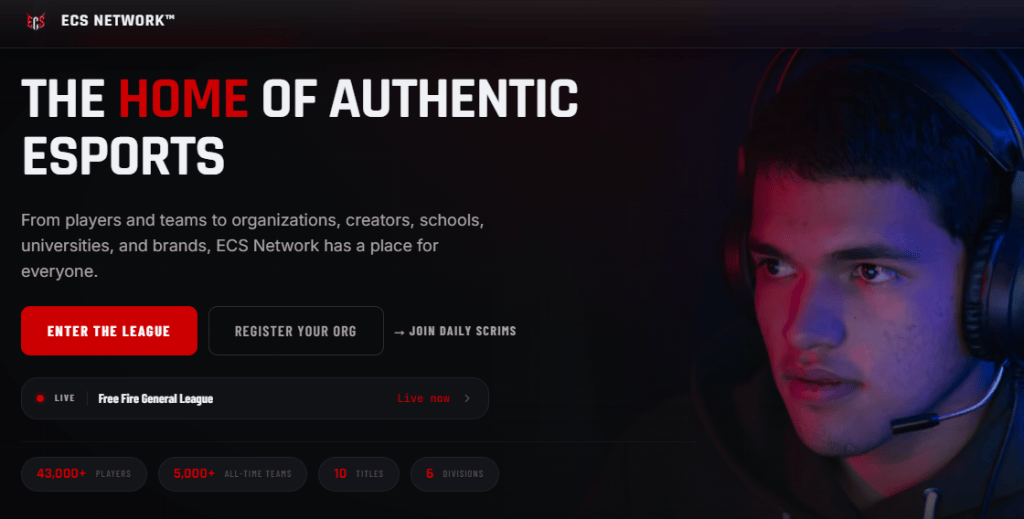
Nigerian esports startup ECS Network has attracted more than 43,000 players and 5,000 registered teams across 10 gaming titles as it seeks to introduce a structured league system to competitive gaming in Africa.
The startup, which launched just over a year ago, is building a competitive gaming platform that allows teams to compete across divisions, earn promotion or face relegation, while players accumulate statistics and rankings beyond individual tournaments.
ECS Network initially focused on competitive Call of Duty: Mobile (CODM) practice matches, commonly known as scrims, before expanding into a broader esports organisation covering multiple games.
Its Chief Executive Officer, Larry Channel, told Disrupt Africa that the company was established to address the lack of continuity in competitive gaming, where players and teams often compete in standalone tournaments with limited opportunities to track their long-term performance.
“A lot of competitive gaming activity was centred around standalone tournaments, where everything essentially started and ended with one event. We wanted to build something with continuity, where teams and players could compete consistently and have their performances tracked over time,” Channel said.
The platform has since introduced a league structure featuring multiple divisions, promotion and relegation, player statistics, team rankings, Most Valuable Player recognition and systems designed to maintain competitive integrity.
According to Channel, while several tournament organisers and esports communities operate across Africa, many focus primarily on individual competitions rather than sustained league systems.
He said ECS Network’s model allows teams to progress through divisions and players to build competitive records, making their performances relevant beyond a single tournament.
The startup now has more than 50 staff members working across different gaming titles and operational functions, including event management, player verification, competitive integrity, rankings, community management and media.
See also: Southeast Asian Startups Face Funding Crisis as Investors Favour US, China
Since its launch, ECS Network has expanded beyond CODM to include titles such as Free Fire, PUBG Mobile, eFootball, FC Mobile, Blood Strike, Mobile Legends and Valorant.
More than 1,600 teams and 15,000 players have competed in its CODM competitions alone, reflecting the game’s role in the startup’s early growth.
Channel said the platform had received a strong response from players and teams, adding that its audience now extends beyond Africa to Europe, North America and the Middle East.
The company plans to expand into additional games and strengthen its position as a wider African esports ecosystem.
ECS Network is self-funded by its management team and has awarded more than ₦75m, equivalent to approximately $56,000, in prize money across its competitions.
Its primary revenue sources are sponsorships and commercial partnerships, with earnings largely reinvested in running and developing the league.
Channel said the funds support events, prize pools, staffing, infrastructure and community development rather than being taken as profit.
However, the startup faces challenges in building a sustainable business in Africa’s developing esports market, particularly in changing how players approach competitive gaming and securing long-term sponsorships.
Channel said convincing players to move beyond the traditional tournament model and embrace a structured competitive journey took time, although acceptance had improved significantly.
He also identified sponsorship as a continuing challenge, noting that the commercial development of esports across Africa remained a work in progress.
“African e-sports is still developing commercially, so securing long-term sponsorship support remains something we’re actively working on,” he said.

About the Author
Cecilia Attah is a tech analyst with a degree from Benue State University. She covers tech news and startups at TechRegard with a focus on how technology is transforming Africa and shaping the global landscape.


